
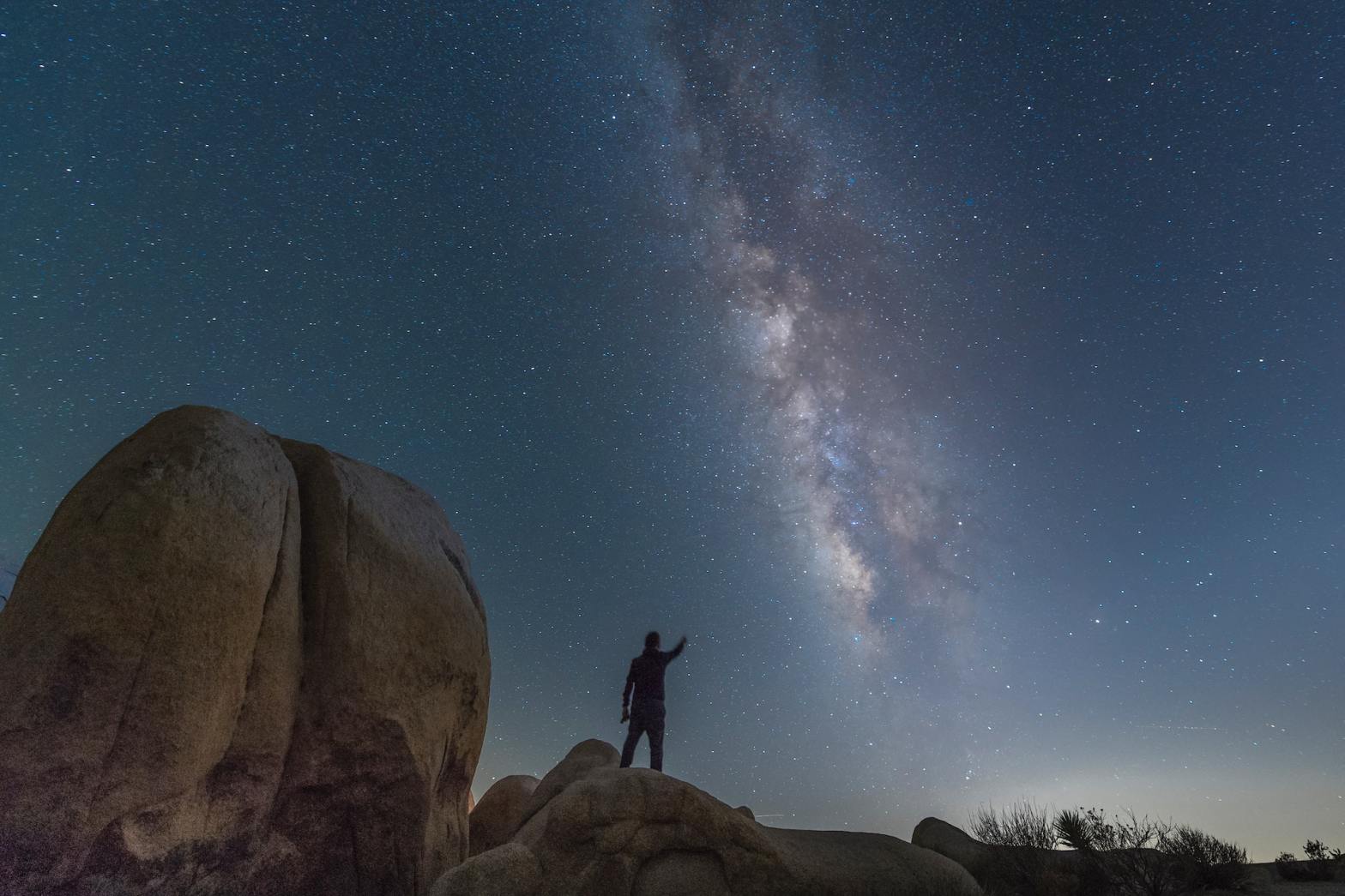
Photo by Ken Cheung
The Shadowed Stars book series by Steven Koutz is a great love letter to science fiction, especially in its pulp fiction roots, where the focus was more on space exploration.
Since time immemorial, humanity has always looked up to the stars and wondered: What is beyond there? For as long as we could remember and for as long as we could write down our thoughts and ideas, space, the sea of stars above us, has always held some deeper intrigue, an eternal fascination. We know there is something beyond the clouds and the sky, and our yearning for an answer has never ceased.
Even when we burst through the atmosphere and saw the vastness of space first-hand, our interest in wanting to know what lies in the great immensity of space has never ceased.
Even when we flew satellites up and pointed telescopes at other solar systems and galaxies, our longing to know the wonders of the cosmos and the possibility that there might be something more than just us humans has never ceased.
We will always be questioning our place in the world and the universe at large, and it will never stop. As long as there is no concrete answer, we will never stop wanting to know.
What Are We Talking About Anyway?
Before we go talk about how science fiction is the reflection of humanity’s deeper longing to expand outward and discover the farthest extent we can reach, we first need to talk about the genre itself.
What is science fiction?
While condensing what science fiction is simply impossible, it is possible to try—I can hear my consciousness laughing at me right now. So, let’s throw an attempt, shall we?
While generally confined to our perception of reality (i.e., it is primarily concerned with human endeavors and our interactions with space and the elements the author has decided to include), science fiction is first and foremost more enamored with the potential that either our species has, given the passage of time and the inventions we are bound to create, or the mysteries that the larger universe hides within its folds, its distant planets and lurking black holes, its massive stars and the like.
With that as the premise, science fiction then further attempts to examine what the results of these potentials have; it wants to portray a reality wherein the consequences are made apparent and, ultimately, try to construct a prediction as to how human society would change to incorporate or take into account the elements presented.
Now, the definition that I just garbled up is—to be respectful to myself and my readers—pretty freaking vague. I could have just pointed to a blurb for a Star Wars film and said this is what science fiction is sometimes like, and it would have made as much sense.
The only reason I didn’t try to do so is because that would be a cop-out, and also, I don’t like to add quotes in my articles (the formatting just bothers me).
Now, with that out of the way, we can now talk about how science fiction helps us.
How Science Fiction Helps Us Realize the Beauty of Nature and Space
Science fiction is a great vehicle for people to work out their ideas and their perspectives about the future and the potential possibilities of humanity, especially when it concerns our yearning for space and our longing for other forms of life to interact with and learn from.
The best, most recent example I can give is the Shadowed Stars book series by Steven Koutz.
While the universe conveyed by Mr. Koutz is quite bleak and, oftentimes, depressing, that is because of the entities and creatures living inside of it and not the reality and nature of space itself. Surprisingly in the Shadowed Stars universe, while galactic empires and polities are dangerous and malignant cancers, there is a romanticism in the vastness of space and the mysteries that still lie hidden within its unchartered territories. You see, space and nature itself are not the reasons why reality is full of suffering and the like; it is solely due to the thinking entities–us humans and whatever exists beyond the pale–and their preconceived ideas of what existing should be.
As Jeff Goldblum’s character says in the first Jurassic Park film, “Life finds a way.” And science fiction helps us find such a way.
 The Damsel’s Files