
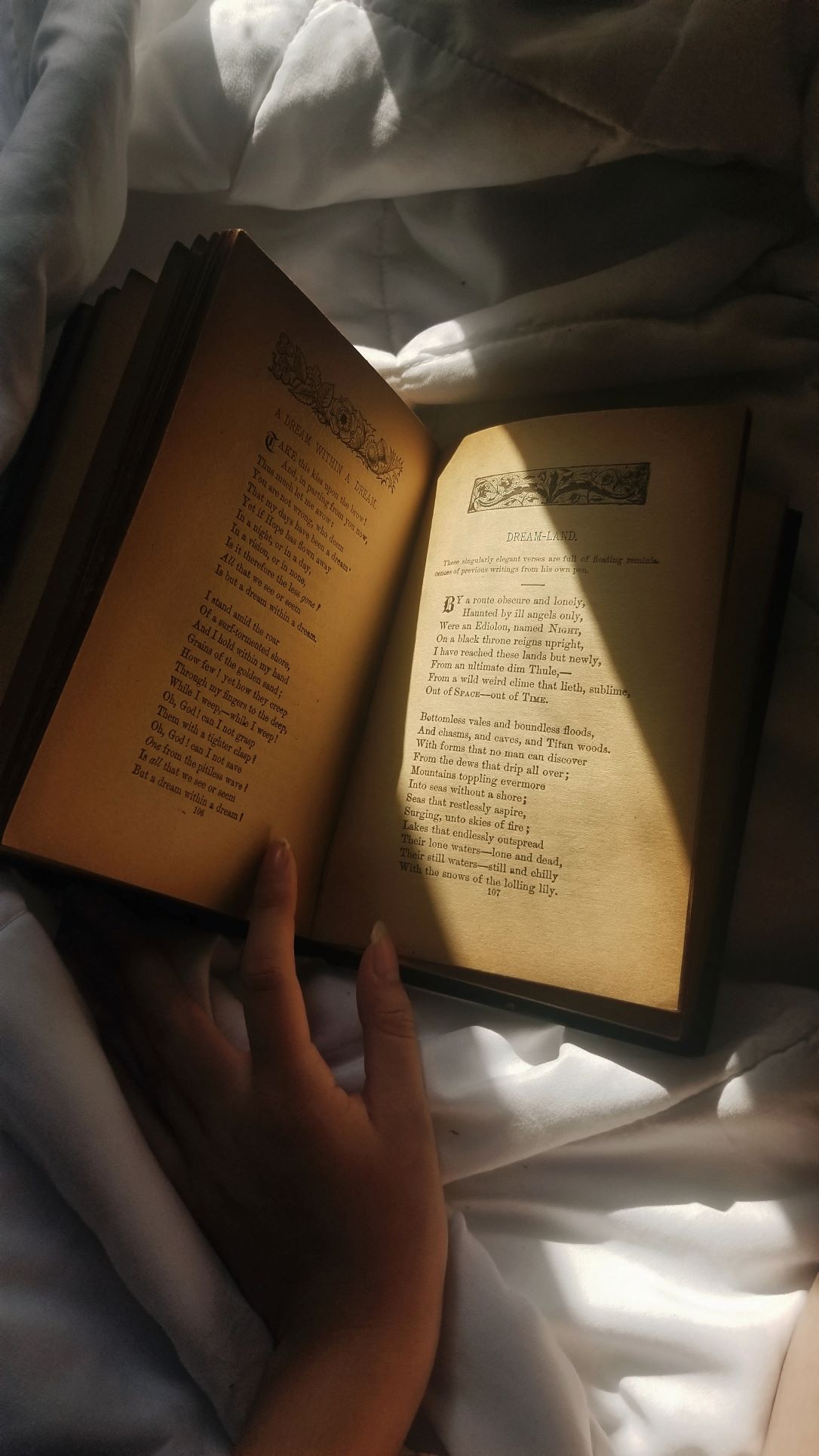
Whether we look for activities that we enjoy or love to do in our pastimes, poetry will bring us into the world of imagination.
Like any other piece of literature, poetry is written to express a particular emotion, feeling, or idea desired by the author. Without a defined format, poems come in various variations, each with its sound, smell, and taste. The most successful lyrics masterfully give readers the Ah-Ha! Experience and conveys in them incomprehensible emotions that render them vulnerable to the poet’s message. William Shakespeare’s Sonnet 18 and Sylvia Plath’s Metaphors adequately contain imagery, lineation, and tone to shape the meaning and rest the reader’s thinking. However, no matter how well the poem may be structured, the poem is nothing without the reader’s interpretation. Poetry is brought to life by the author’s ability to use words in combinations that lead readers to make their own stories.
A poem is a moment written tactfully and captured by the poet without limitations. Nevertheless, the poet writes the poetry with the clear conviction of pulling the reader into its hold and taking them through a journey of boundless experiences. The poem’s value comes from the reader, and if a poem can jolt and surprise those who read it, then it has successfully come to life; something about that poem was able to clasp the complex mind of a reader. The connection formed between the poem and its reader dictates the grandeur and entity of the poem itself.
Below are some of the poems that will interest you to read such:
Haiku. The haiku (or hokku) is an ancient Japanese form of poetry that has become very popular worldwide. It consists of unrhymed, short lines. These lines can take many forms of brief verses. However, the most common haiku structure features three lines of five, seven, and five syllables. A haiku poem generally presents a single and concentrated image or emotion. Haiku is considered a fixed poetic form and is associated with brief, suggestive imagery intended to evoke emotion in the reader.
Free Verse. Free verse poetry has no fixed metrical pattern and no rhyme scheme. Often echoing the cadences of natural speech, a free verse poem makes artistic use of imagery, sound, and a wide range of literary devices. It is a popular style of modern poetry, and as its name suggests, there is a fair amount of freedom when writing a poem like this. Free verse can rhyme or not, it can have as many stanzas or lines as the poet wants, and it can be about anything that interests you!
Sonnet. The sonnet is a type of poem that has been a part of the literary repertoire since the thirteenth century, made famous by William Shakespeare. It originated in 13th century Italy, perfected by the poet Petrarch. Traditionally, sonnets usually deal with love and consist of 14 lines. As a rule, Petrarchan (Italian) sonnets follow an ABBA ABBA CDE CDE rhyme scheme, whereas Shakespearean (English) sonnets are typically ABAB CDCD EFEF GG. But of course, rules are made to be broken! Sonnets can communicate various details within a single thought, mood, or feeling, typically culminating in the last lines.
Limerick. Limericks poems are usually fun poems designed with humor (sometimes rude!), but that doesn’t always have to be the case. They are sometimes scanned, and the final line is designed to make people laugh. A limerick contains just one stanza, a group of lines within a poem, much like a verse within a song. When discussing how poems rhyme, we often refer to it as a rhyming scheme. In the case of the limerick, the rhyming strategy is AABBA.
Nevertheless, some of us prefer poems that focus on the nature of love. The subject of ‘Love Poetry’ has given rise to some of the most fascinating and beautiful poetry. The poets illustrate the people’s feelings concerned with them or their own emotions through figurative and expressive language. Raymond Quattlebaum is one to consider when looking for poems that express love and life. His books “The Color of Love” and “Poetry in Motion” describe the miracle of life, decorating the essence of who we indeed are within ourselves and the expression of ourselves through life, respectively.
In closing, poetry is universal. Timeless. Yet, it is also very individual, filtered by our own lives and expectations.
 The Damsel’s Files